Home / All projects / Case study
Concordia University · 2015 to 2017
Concordia University projects
My Master of Engineering, Electrical and Computer Engineering, with a telecommunications focus. These are the projects behind the work I do today on fibre, streaming and voice.
High-capacity fibre: 33-channel DWDM link
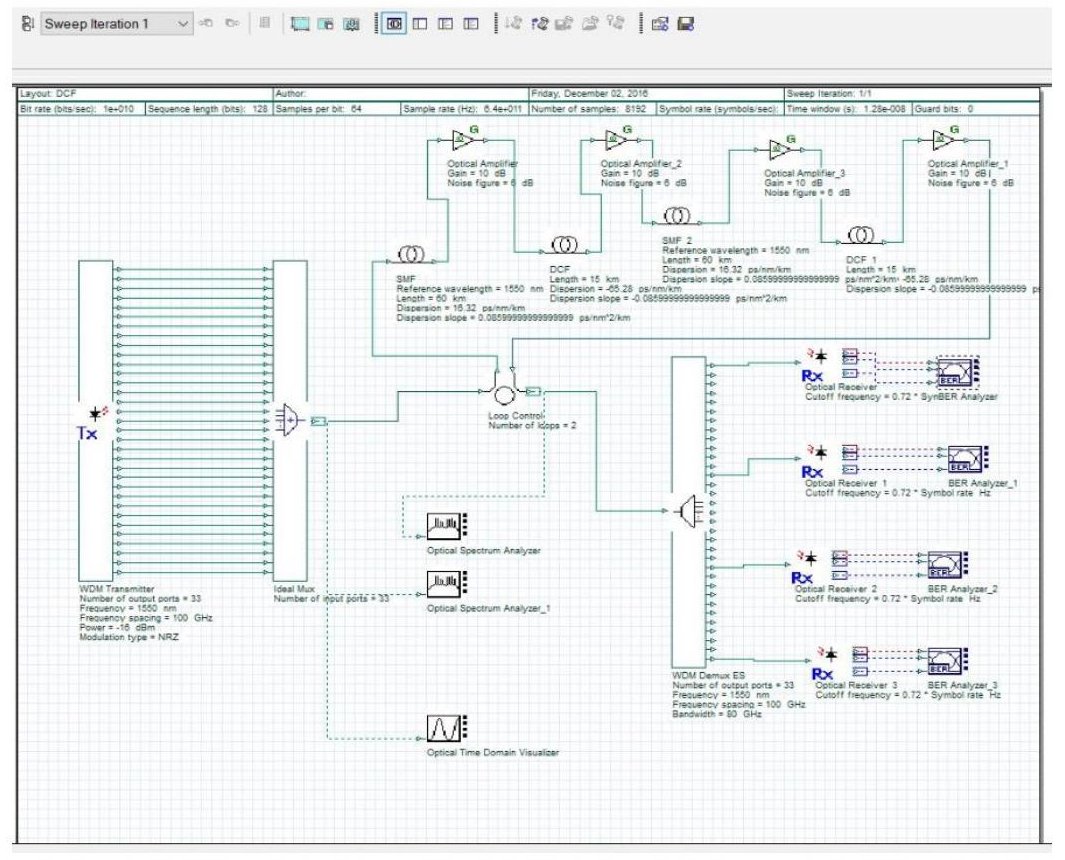
ELEC 6871 Fiber-Optics Communication Systems and Networks, team of 2, December 2016. We designed a high-capacity system to link Montreal and Quebec City over 300 km of Corning SMF-28e fibre, then simulated it in OptiSystem 14.1.
- 33 DWDM channels.
- Two 150 km loops, each 120 km of single-mode fibre plus 30 km of dispersion-compensating fibre.
- 8 optical amplifiers at 10 dB gain and 6 dB noise figure.
- Full power budget (39.5 dB per loop) and dispersion compensation.
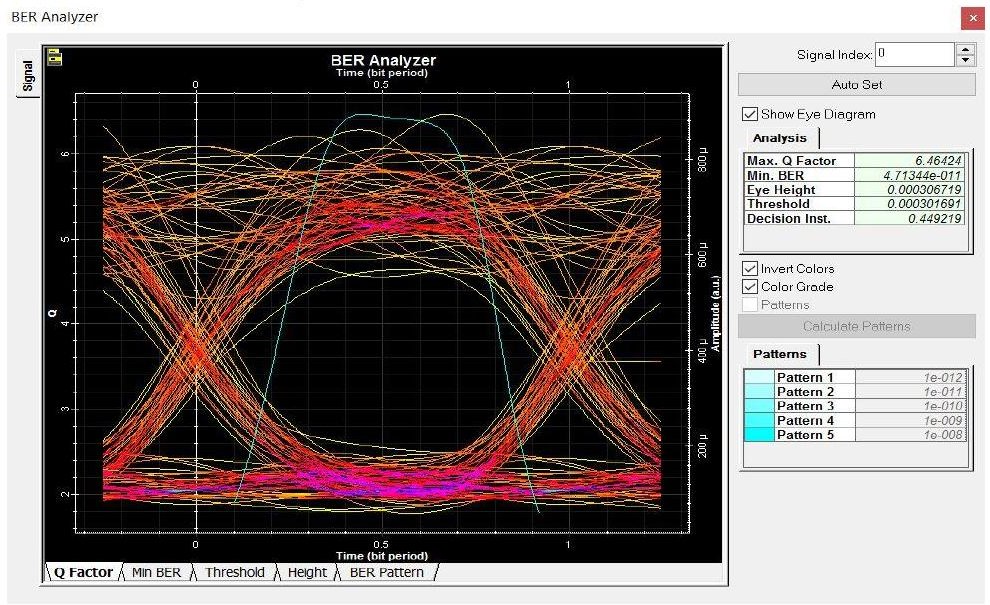
- Channel-by-channel Q factor and bit error rate checks with eye diagrams.
- A cost estimate of $318,000.
Optical amplifier design (EDFA)
ELEC 6871, individual project, November 2016. A two-stage Erbium-doped fibre amplifier for the C band, simulated in OASIX 3.1.
- 38 channels at 100 GHz spacing, 1530.33 to 1559.77 nm.
- 980 nm pump at 150 mW on both stages, to keep cost down with one pump wavelength.
- A 40 dB isolator between stages, and a custom filter to flatten gain.
- Noise figure peaked at 1.82 dB, well under the 6 dB limit.
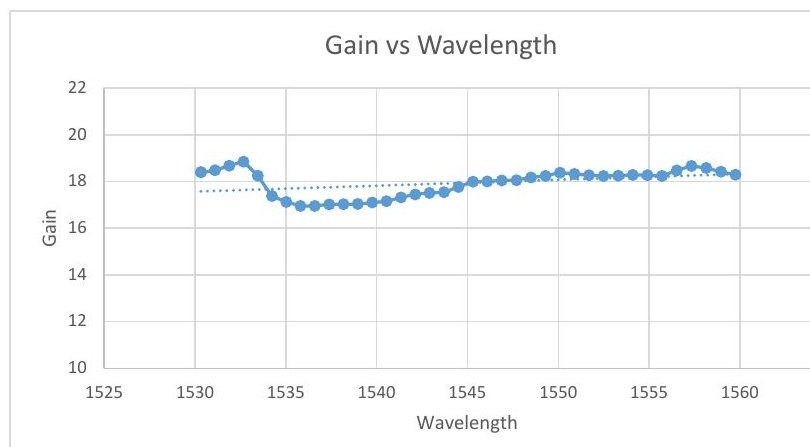
In the lab, as a team of 2, we characterised a real EDFA: gain fell from 13.60 dB to 9.18 dB as input power rose from -20 to -10 dBm.
Real-time multimedia and QoS labs
ELEC 6181 Real-Time and Multimedia Communication over Internet, team of 2, winter 2017. This is the course closest to my job today: how voice and video behave on a loaded IP network.
- Configured Cisco 3925 routers and measured traffic with SolarWinds and Cisco IP SLA (UDP echo, VoIP and FTP).
- Compared FIFO, priority, custom and weighted round robin queuing.
- Worked with policing and shaping, RSVP and weighted fair queuing.
Telecom network simulation
ELEC 6851 Introduction to Telecommunications Networks, winter 2016. A Qualnet simulation of UDP and TCP over a wireless network: 25 nodes in 4 subnets, 600 seconds.
- UDP delivered all 992,897 bytes sent, with 17.05 ms average delay.
- TCP carried 1,064,960 bytes at 818,181 bit/s.
- With fading, UDP delay rose from 18.2 ms to 33.3 ms and server throughput fell from 36,572 to 32,062 bit/s.
Formal hardware verification
COEN 6551, team of 3, June 2017. Equivalence checking of a digital signal synthesizer core: synthesised the design with Synopsys Design Vision, then compared Synopsys Formality and Cadence Conformal. Formality flagged 20 failing points and Conformal 41, and the fix touched 11 gates. It is less related to my work today, but the habit of proving a change before accepting it carried over.